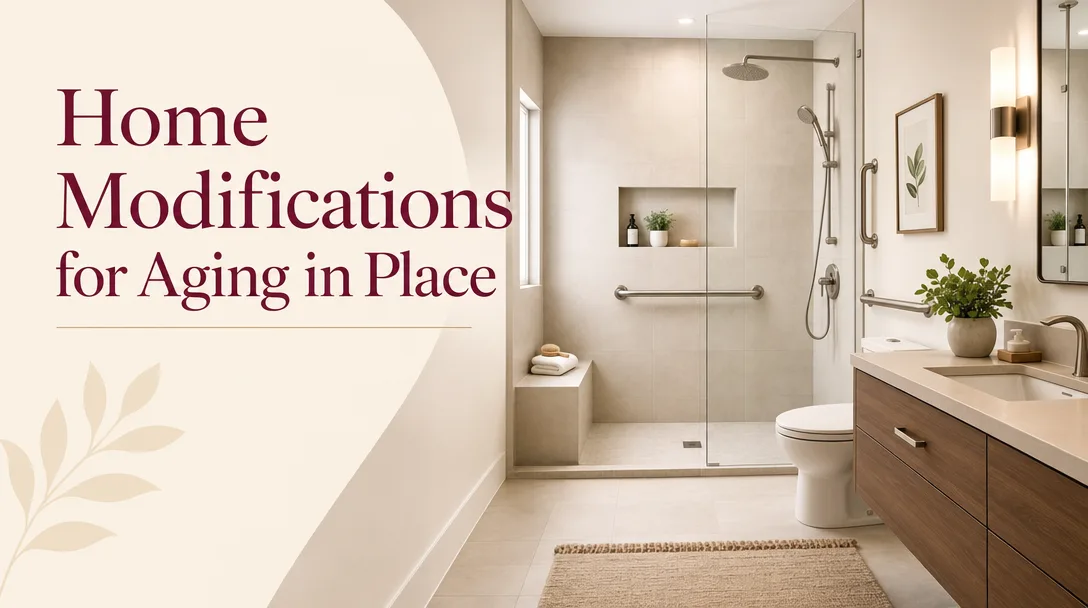

Most articles about aging in place talk about the idea. Few talk about the actual work involved, because most of the people writing them aren't the ones who'd be doing it.
I run a licensed general contracting company. Here's what modifications actually involve, what they cost, and how to think about them against the alternative of moving.
The Core Modification List
Every home is different, but most aging-in-place projects pull from this same list.
Bathroom:
- Grab bars with reinforced blocking behind the wall, not just anchored into drywall
- Curbless or walk-in shower conversion
- Raised or comfort-height toilet
- Non-slip flooring
Entry and mobility:
- Zero-step entry or a ramp at the main entrance
- Widened doorways and hallways for a walker or wheelchair
- Lever-style door handles instead of round knobs
- Improved lighting, especially at stairs and transitions
Layout:
- Converting a den, office, or dining room into a main-level bedroom
- Adding or relocating a full bathroom to the main level
- A stair lift, where a full main-level conversion isn't feasible
What These Actually Cost
Real numbers, in ranges, because a specific quote requires seeing the property.
Small modifications (grab bars, lever handles, lighting upgrades, non-slip flooring): typically a few hundred to a couple thousand dollars.
Mid-range work (a curbless shower conversion, a stair lift, widened doorways): typically several thousand dollars up to the low five figures.
Major renovation (converting a room into a main-level primary suite, adding a full bathroom): this is a full renovation project. It needs to be scoped individually, and any number quoted without seeing the home and its existing plumbing and framing is a guess, not an estimate.
The number that matters most: get a written scope of work, not a verbal walk-through estimate. A real scope specifies exact materials, exact labor, and a firm price, so there are no surprises once work starts.
The Real Comparison: Modify or Move
This is the calculation almost nobody walks through side by side.
Cost of modifying: the renovation itself, which could range from a few thousand dollars for basic safety modifications to $30,000 or more for a full main-level suite conversion.
Cost of moving: commissions, closing costs on both the sale and the purchase, and moving expenses typically combine to run 8 to 11% of your home's value. On a $700,000 home, that's $56,000 to $77,000 before you've accounted for the price difference between homes.
Run both numbers using the downsizing cost calculator before deciding. And for the full side-by-side of the three paths, see our guide to staying in your home, modifying it, or moving.
The question that actually decides it: how many more years do you realistically expect to live in this home? A $30,000 renovation that buys five to ten additional years in a home you already own outright, in a neighborhood you already know, is often the stronger financial decision, not just the more comfortable one. A home with structural issues that make real modification impossible, three levels with no way to add a main-level bedroom, for example, tips the other way.
Run both numbers before deciding. Don't assume either direction without them.
Questions to Ask Before Hiring Anyone
- Is the contractor MHIC licensed? In Maryland, this is required for home improvement work over a certain threshold, and it's your protection if something goes wrong.
- Will I get a written scope of work with specific materials and a firm price, or just a verbal estimate?
- Has this contractor done aging-in-place-specific work before, not just general renovation?
- What's the realistic timeline, and how will the home stay livable during the work?
Frequently Asked Questions
How much does it cost to add a main-level bedroom for aging in place?
This depends heavily on your home's existing layout and plumbing. It's a full renovation project, typically in the tens of thousands of dollars, and should be individually scoped rather than estimated from a general range.
Is a stair lift or a main-level bedroom conversion better?
A stair lift is usually the lower-cost option if the upstairs layout otherwise works. A main-level conversion is the stronger long-term solution if stairs will eventually become unusable altogether, not just difficult.
Do I need a licensed contractor for aging-in-place modifications in Maryland?
For most home improvement work above a minimum dollar threshold, yes, an MHIC-licensed contractor is required. This also protects you legally and financially if a dispute arises.
Is it cheaper to modify my home or move to a smaller, more accessible one?
Often modifying is cheaper, once you account for the 8 to 11% combined cost of selling and buying. It depends on your specific home's condition and how many more years you plan to stay.
Where to Start
For a written scope and quote on modifying your current home for aging in place, reach out to Operations Group LLC for a free consultation: (202) 497-0913.
For the real estate side, if you're weighing modification against a move, or want to know what your current home could realistically sell for, reach out for a free consultation: schedule online or call (301) 660-6272.
Not sure modifying is even the right call for your neighborhood? See Is Aging in Place Practical in Rockville, MD? or Is Aging in Place Practical in Silver Spring, MD?
For the full picture, including the sale-and-stay option, see the complete guide to aging in place in Rockville and Silver Spring.
Operations Group LLC is a licensed general contractor in Maryland, MHIC #05-160028. This article is for general information only. Get a written, in-person quote before making any renovation decision.